
Category Archives: About Seamus
Seamus’ Last Adventure
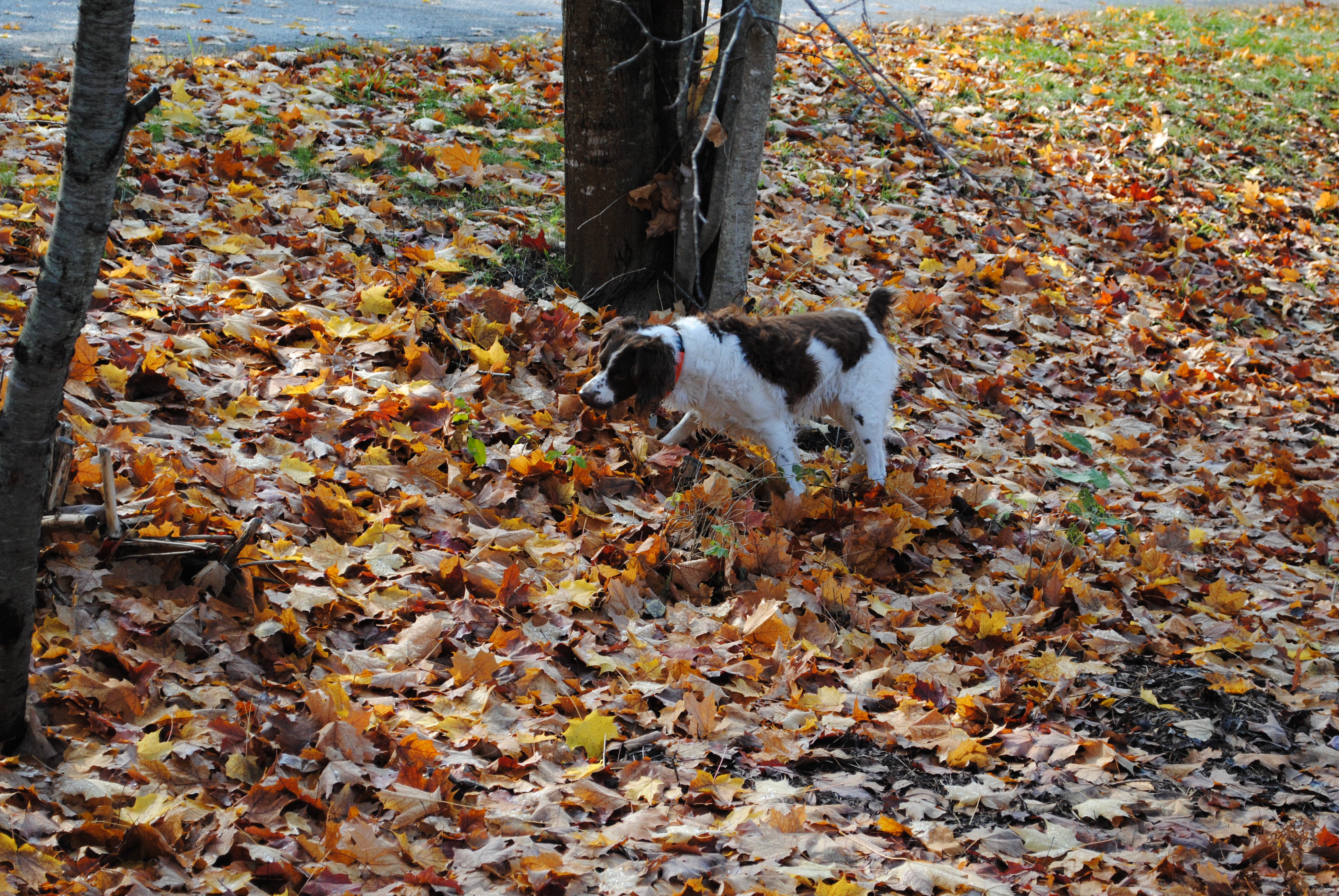
It’s been ten days since I held Seamus last, stroking his face and rubbing his ear, all the while telling him in as soothing a voice as I could muster without cracking, “Daddy’s here, everything is alright.”
Within a few minutes the sedative took hold and Seamus relaxed for the first time in weeks; not gasping for breath. He was calm and I hope knew the two people who loved him most were there with him while the vet administered the last injection that stopped his heart.
My wife and I had dreaded this moment for weeks. For the past couple of months, Seamus, who was now 13 ½ years old, was diagnosed with upper airway disease that included laryngeal paralysis.
Hearing the diagnosis my head swirled grasping for options, none of which were promising. I decided to get a second opinion and took him to Michigan State University Veterinarian Hospital on the MSU campus. The examination and evaluation came back the same. Further testing could be done, but no one was optimistic. His age was a concern that he might not have survived the anesthetic.
That was on December 13 and for the next 51 days, “She Who Must Be Obeyed” and I dotted on him, took him Up North for the last time and gave him our utmost attention and love. On February 2, we knew it was time to show him the most love we could muster.
It’s been ten days and today is the first time I could focus enough to write his obituary.
SEAMUS
08/13/2005 – 02/02/2019
“A Brittany, hunting partner, companion ….our friend.”
Category Archives: About Seamus
Bloody nose and all …
Though brown and dying, the ferns were as tall as my waist making it almost impossible to see Seamus. His bell was the way I knew where he was except when we hit a patch of clearing or clump of pines with depressed grass where deer had been laying.
It was the silence of the bell that got my attention and had me walking to where I heard it last. Usually, the bird would flush before I found him in a statuesque state, but this time there was no flush. I got within ten feet before I saw him frozen, nose pointing at a spot of matted grass and ferns next to a downed log by a pine. I was approaching from his right, slightly ahead, making my way toward where the spot that held his attention.
Woodcock sometimes make a whistling sound as they lift off like a helicopter, but not this time. A muted sound of wings grasping for air and a small bird with a long bill made his presence known …but only momentarily. He never got more than two feet over the ferns, turned sharp right and disappeared behind the pine. By the time I shouldered the 20 ga., he was out of sight.
This was the story at least twelve more times this morning; the ten year old Britt working like he was three. It was all I could do to try and be there when the bell went silent.
We covered about two miles of great bird cover and, though not the majority, some wound up in my game pocket. It was a good hunt that could only have been better if the ferns were down along with more leaves …and my shooting was better.
Seamus had to be called off (tricked really) to make him stop hunting. When finally I got him close enough to touch, I saw he was bleeding from his muzzle. We had gone through a patch berries with thorny stalks. While they slowed down my walking as they grabbed my legs, Seamus bulled his way through and found another bird.
The Woodcock were definitely in and Seamus had a ball.
TD
Category Archives: About Seamus
Guilt
Despite the heat, grouse season opens in six days. It’s really more of a tradition to hit he woods on opening day; it’s not really a serious hunt, after all, you’re relying on following the jingling of a bell or beeper to get a momentary glimpse of a bundle of feathers heading for daylight between branches and leaves. Still, even an empty game pocket can be satisfying at the end of the day as you stroke a tired dog with a warm smile on your face, appreciating your time together …funny how things can put a smile on your face and if you’re really pressed to tell the truth, make your eyes a little moist too.
I took Seamus to the vet yesterday to get his teeth cleaned. “She Who Must Be Obeyed” made me do because Seamus’ breath has been getting strong lately and, at ten years old, they’ve begun to look a little worrisome. So, after talking it over with him, we agreed to visit North Main Animal Hospital.
Now, I get my teeth cleaned several times a year and, though not liking it, I tolerate it and haven’t bitten the hygienist yet …I’ve wanted to a couple of times, but so far, so good. Seamus, on the other hand, had to be given an anesthetic – it seems the hygienist wasn’t willing to give him the benefit of the doubt.
I took him in at 8:30 in the morning and picked him up at 4 in the afternoon. The report of the procedure (you can see where this is heading) was that all was good – no extractions were necessary – but it took almost 15 minutes to tell me that. So with anti-inflammatory pills, anti-biotic pills and a wish I had taken him to my dentist that takes my health insurance, I brought Seamus home.
He was still groggy from the anesthetic and would have liked to sleep it off a bit longer, but when he saw me, he did a yeoman’s job of laboring to the car where he tried to jump in the back but needed a little help. Once home, he walked right by his food dish – something that seldom happens – and headed straight for his favorite chair next to the front window.
Well, I tell you, I had guilt oozing from every pore. As soon as I sat down, Seamus jumped (more accurately, fell) down from the chair and positioned himself at my feet, making sure to touch me. I choked up and couldn’t get down on the floor with him fast enough where I spent the next half hour stroking him, trying to sooth my guilt.
All this didn’t go un-noticed by “She Who Must Be Obeyed” who was still on the mend from a knee replacement from the week before. After a few minutes she casually mentioned that I was giving Seamus more attention than I gave her when I brought her home from the hospital.
I thought about that for a minute and wanted to say, “If you found birds for me like he does, I’d lay on the floor with your too.” But having been married for 46 years, I kept my mouth shut and invited her down to join us.
TD
Category Archives: About Seamus
A cold drink on a hot day goes a long way.
In fifteen days, grouse season will be open and not a day too soon. All though the best hunting won’t happen until the leaves turn and fall, it will be a great day for those who want to walk the woods in anticipation of finding …or your bird dog finding, bonasa umbellus with your favorite 20 gauge.
Having said that, it’s hot. And it will be hot on the 15th, too.
Years ago, when the Put ‘n Take Pheasant program was in operation in the state, I ran into a man and his son, hunting a “Red Dog.” The encounter sticks in my mind for two reasons: first, he corrected me when I called his dog an Irish Setter instead of a “Red Dog;” and second, he pulled out a thermos of cold water and a collapsible bowl he carried just for the dog. I was hunting over a beagle at the time and always had water in the car, but not on me, and I relied on finding a source of water during the hunt, which I usually did. When he poured the water into the bowl, his dog knew it was for him and it was obvious, he appreciated the consideration.
The long and the short of the story is, he convinced me to carry (before bottled water) a canteen of sorts just for the dog, because you never know what conditions you’ll experience, or more importantly, your dog will.
Seamus goes like a machine when he’s in his element, and sometimes that means he’ll go right over or around a creek or puddle when he’s hot on a scent. Being able to stop and pour him “two fingers” of his favorite libation (water) is not only a kind thing to do, but will save him from exhaustion, especially on a hot September day.
Oh yes, save the “two fingers” of your favorite libation for when you get back to camp ….I was going to say car, but I didn’t want a lot of comments from the Puritans.
TD
Category Archives: About Seamus
Happy birthday, Big Guy. It’s been a great 10 years!
Today is Seamus’ birthday. I don’t think he knows it’s his birthday – or what a birthday is for that matter – but today is his day and there is no argument about his being king for the day …at least not between “She Who Must Be Obeyed” and me. For Seamus, it’s probably hard to tell the difference between today, yesterday and tomorrow, he has it pretty good, everyday.
We just got back from the cabin where I spent more time than usual letting him run along the shoreline of Lake Michigan and in the Jordan Valley following the river where he got into his hunting mode. Next month, we’ll be back with me carrying the old 20 gauge o/u, hoping for a clean shot at bonasa umbellus in cover that is now covered with heavy foliage.
The biggest change in his approach to finding grouse will be his pace. At 10 he’s slowed down some, but not enough to take away his enthusiasm for what he was bred for and looked forward to for the past nine seasons. Even his first year, at five months old, I took him to a hunt club and had pheasants planted to see what he’d do and found out he was a gamer; the research of breeders paid off.
But grouse season is still a month away and at his age conditioning is important. He doesn’t know what it is to quit, so it’s up to me to make sure he’s able to withstand the exhaustion he’s up against in the early season and know when to call him off when he doesn’t want to quit.
Having said all that, to day is his birthday and that means an extra piece of bacon for breakfast and a lot of tending to the rest of the day – something that happens when kids grow up and move away.
Happy birthday, Big Guy.
TD
Category Archives: About Seamus
Traveling with the king!
Seamus and I have taken many trips together over the past ten years; some were of significant duration, meaning we spent many hours in the car. But this last trip to Wyoming set the mark for stamina …both for Seamus, “She Who Must Be Obeyed” and me. Three days driving to get there, three motels (dog friendly, of course) and over 90 degrees daytime temperature – thank God for air-conditioning.
Seamus is used to 4 hours in the car with no problem, that’s how long it takes to get to the cabin, but anywhere from 9 to 12 hours, adjustments needed to be made.
First, frequent stops to let him stretch and do what he had to – not to mention letting the blood flow back into my lower cheeks – but it became clear after hitting I-80 that a new configuration of the back of the Jeep had to be devised to get him to lay down. It seems he took exception to the passenger seat being occupied by “She Who Must be Obeyed.” (I suggested the obvious solution but it didn’t go over well.) So after rearranging the baggage, one of the back seats was put up and he finally laid down instead of standing on the console, his head between mine and “She Who Must Be Obeyed,” looking out, making sure we were heading in the right direction.
It didn’t take long for him to adjust to the motels. Once he saw two queen sized beds, he knew he could tolerate the inconvenience of sleeping somewhere other than his bed at home – mine.
The amenities were to his liking too: frequent offerings of fresh cool water; sharing a piece of cheese, summer sausage or sandwich, and of course, ice cream.
The only thing he didn’t do that we did, was take pictures.
It’s a good thing he can’t read, the ranger at the entrance to Yellowstone gave us a paper that outlined restrictions of pets in the park. The one I kept from him was the idea he could be bear bait if I let him wander off.
Two weeks and 4,100 miles later we’re home. From now on the 4 hour ride to the cabin will be a breeze.
TD
Category Archives: About Seamus
You have your rituals, I have mine!
I thought I was dreaming, but the second or third time his paw touched my face, I opened my eyes and was met by a sight of anxious eyes and perked up ears. Seamus was telling me something.
The clock next to my bed said 12:45 am – though sleeping soundly, I thought it was later. I must not have moved quickly enough for the little Britt, because he decided to swipe my face with his paw one more time – he does it so soft and gently I don’t react to protect myself. This last swipe was a little more forceful.
I asked him what he wanted and immediately he ran to the back door, jumped up as to open it and whined. I got the message.
Half dressed (it was dark, no street lights) I opened the door and followed him outside. He ran for a twenty or so yards then found a spot and did what caused him to wake me. Then, getting his relief, he decide to go exploring.
Trying not to cause lights to go on in the surrounding cabins, I bid my time hoping he was as anxious to get back to bed as I was. He wasn’t. So wanting to bring this to a conclusion, I got the Jeep and drove down the lake where he usually comes out and waited. Sure enough, twenty minutes later, here comes a cocky liver and white Britt. I opened the back door and without a command, he jumped in and immediately stood on the center console looking straight out of the windshield. He was ready to go back.
As I pulled into the driveway and opened the door, Seamus, now ready to go to bed, pushed past me and jumped out and sat on the porch waiting for me to catch up.
What ever it was that caused that disruption to a good night’s sleep was gone. He was curled up on the foot of my bed, eyes closed, long before I managed to get undressed. I decided I’d get even; at four o’clock, it was my turn to wake him up. Instead of getting out of bed without disturbing him, I kicked him off of the bed and told him, “How do you like it?” He moaned and jumped back up, hardly missing a snore.
TD
Category Archives: About Seamus
The nose knows!
Finally, after waiting out the long cold frozen winter and early spring, the steep two track leading to Seamus’ favorite spot along Lake Michigan is ice free. (But not rut free.) The little Focus made it down the hill and over most of the ruts and finally to the clearing where the “adventure” begins.
Pools of water dot the beach and branches and driftwood cover the dunes. It hasn’t been long since the last ice vanished, but it won’t be long before the storms churn up waves that will clean the beach and establish a skirmish line separating the tall rough grass from the damp sand holding stones and rocks – some of which are the mosaic looking Petoskey Stones.
Seamus covered the beach like a flushing dog quarters a field of corn stubble. He was here, there, and then here again. He came to a sudden halt and turned so fast his hind legs almost collapsed. He found a snake. The snake made straight for the opening under the rock and disappeared. Seamus had to be called off, he was having a ball.
TD
Category Archives: About Seamus
It may not be with words, but I swear Seamus can talk!
I’m not sure if it’s just his curiosity or a characteristic of being a bird dog. Every morning, Seamus climbs on the back of the loveseat and sits there like a grouse on a tree limb. He sits there looking out the window and lets me know when someone walking a dog goes past he house.
This has been going on for years – at least ever since “She Who Must Be Obeyed” decided to move the loveseat next to the window – and he’s developed a code I can recognize for each dog in the neighborhood that goes by. If it’s a cat …well, he just plain goes nuts; even the neighbors can hear him.
With the advent of spring, it’s just a matter of time before he gets to run in the fields along the Jordan, where we hunt grouse. But only for a short while, the middle of April closes dog training on state land. That doesn’t prevent from walking a dog on a leash or tether, but, Seamus is rarely on a tether up north, so the romps along the Jordan will be short-lived and replaced by the long walks along Lake Michigan …once I can get the Jeep down the embankment.
There are benefits to running Seamus along Lake Michigan: Later in spring, carp can be seen spawning in the lagoons and shallows. Beginning in late May, my 8 wt will be in the car, just incase I see dorsal fins sticking out of the water amongst the reeds and other vegetation.
It works out for both of us, be both get some exercise and we both get fixated by what we see or smell. Our roles change there along the mile long beach; it’s one of the few times Seamus has to wait for me to get through. But he’s adapted to that too, he’s developed a special bark that lets me know he’s waiting.
TD
Category Archives: About Seamus
The “King” is back!
The clock read 4:14. I wasn’t sure why I woke and looked at the clock, but then it happened again; Seamus was slapping my arm with his paw, inching his way toward my face. Making no sound, he inched his way on top of the covers until he was able to touch me and get a reaction.
It was useless to try and make him lay back down for another hour or so, so after a couple of commands of “get down,” I gave up, got up and got dressed for an early morning walk …run, for him.
It had been hard on Seamus back home not being able to run. Somehow, going for a walk on a leash isn’t enough. He’s used to running in the fields and woods by the cabin. Snow is just a little inconvenience, something he turns into a plaything as he jumps the drifts, burrows under the surface with his nose and sends the snow flying when he sneezes.
There was plenty of snow on the ground and in the woods and field; snow that was undisturbed except for deer and small critter tracks, and Seamus was checking out each and every one of them. I was lucky he was preoccupied with the tracks, it was so dark, there was no way I would have been able to see him if he took off after something that caught his attention.
We covered our usual route and when I made the turn to head back to the cabin where “She Who Must Be Obeyed” would have coffee waiting, Seamus ran alongside without having to be beeped.
The “King” was back and made his return known by marking every snowdrift, tree and fencepost. Now it was time to head back to the cabin and go through his next routine until I come up with his idea …bacon!
TD